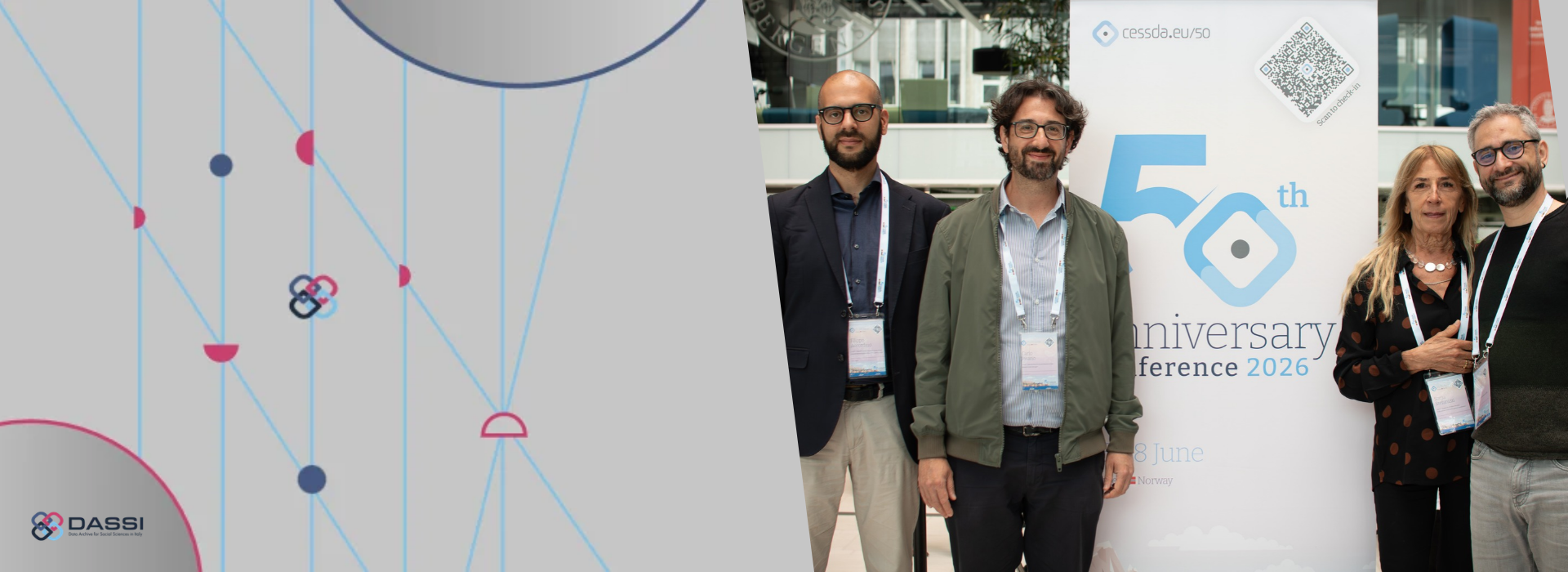
DASSI, CESSDA and the FAIR principles: two new open access chapters
Posted on 02/11/2026
DASSI is the focus of two new open access chapters published by Springer and authored by DASSI researchers, on European experiences with research infrastructures for the social sciences.
1. In the volume Longitudinal Data Infrastructures in Europe. Tools for Open Science in Social Science Research, which explores the opportunities and challenges of panels, research infrastructures and open science, the chapter The Consortium of European Social Science Data Archives (CESSDA) and the Data Archive for Social Sciences in Italy (DASSI) introduces CESSDA, the consortium of European social science data archives. It explains how the consortium helps national archives work together, share expertise and build services for depositing and finding high-quality data, and it covers CESSDA’s history, organisation and tools. It then describes DASSI, CESSDA’s Italian service provider, set up in 2021 as a Joint Research Unit of the University of Milano-Bicocca and the National Research Council (CNR). It outlines DASSI’s goals and archiving workflow: data curation and preservation, metadata and the deposit procedure.
The Consortium of European Social Science Data Archives (CESSDA) and the Data Archive for Social Sciences in Italy (DASSI)
By: Filippo Accordino, Fabrizio Pecoraro, Daniela Luzi, Carlo Pisano, Domingo Scisci
In: L. Taddei, M. Paolucci (eds.), Longitudinal Data Infrastructures in Europe. Tools for Open Science in Social Science Research, Springer, Cham, 2026, ch. 7, pp. 91–105.
DOI: 10.1007/978-3-032-07005-0_7
2. In the volume Research Infrastructures for Open Science in Social Science Research. Lessons from the FOSSR Case, which uses the FOSSR project (Fostering Open Science in Social Science Research) as a case study of research infrastructures for open social science, the chapter From Principles to Practice: FAIR Data and the Infrastructural Turn in Social Science traces how the FAIR principles (Findable, Accessible, Interoperable, Reusable) have moved from a conceptual framework to an infrastructural model for social science research today. It sets out their theoretical, ethical and epistemological foundations and their link to Open Science. The authors look at European and global infrastructures such as CESSDA, CLARIN, DARIAH and the European Open Science Cloud. For Italy, they focus on DASSI and FOSSR as local FAIR ecosystems with international connections. In the authors’ view, FAIR is more than a technical standard: it is a new social contract for responsible, inclusive and sustainable knowledge production.
From Principles to Practice: FAIR Data and the Infrastructural Turn in Social Science
By: Sonia Stefanizzi, Domingo Scisci
In: G. Cerulli, E. Reale (eds.), Research Infrastructures for Open Science in Social Science Research. Lessons from the FOSSR Case, Springer, Cham, 2026, ch. 3, pp. 61–84.
DOI: 10.1007/978-3-032-29575-0_3
- cessda
- dassi
- FOSSR